


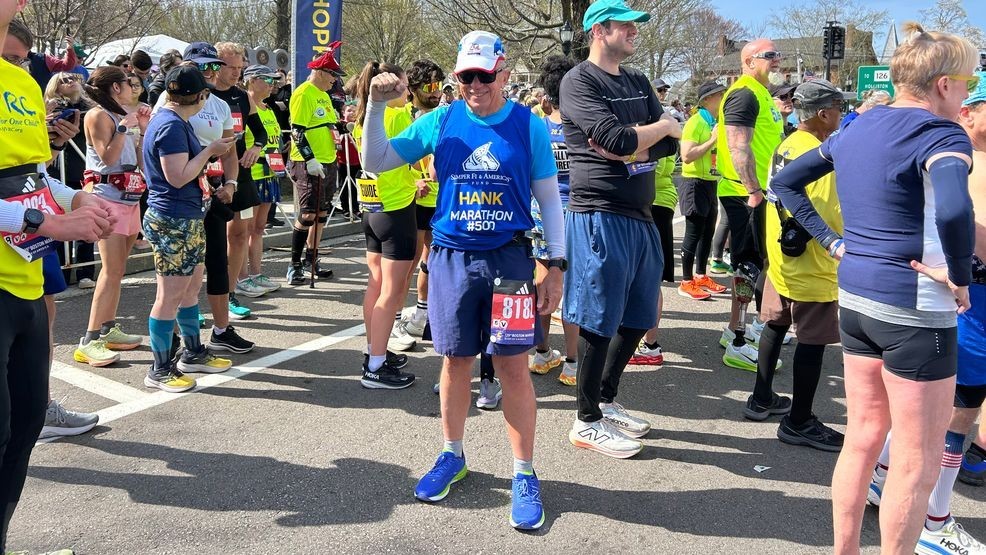
Running has often been called a solitary pursuit, yet the stories that emerge from within this space reveal complex threads of community and personal resilience. Hank Donigan’s journey through 500 marathons, culminating at the Boston Marathon, is a testament to endurance not simply as a sport, but as a means of connection, healing, and purpose.
In a landscape where every mile can initiate a clash of mind and body, Donigan has learned that running offers more than just the heartbeat of a competitive clock; it serves as a cathartic outlet, a form of solace that allows him to navigate both the external chaos of life and the internal struggles that can feel insurmountable. For those of us who have spent countless hours training through seasons of highs and lows, this dynamic is familiar. The rhythm of feet pounding pavement serves as a meditative practice, allowing time for reflection amidst the grind.
Donigan’s background as a Marine and a cancer survivor speaks to the unique intersections of resilience found in endurance sports. He experienced the harrowing weight of post-traumatic stress disorder, a chronic partner for many veterans that can often feel as heavy as a physical burden. Upon his return from deployment, Donigan noticed the needs of fellow service members. The ward of a naval hospital can seem sterile, yet filled with raw emotion. Observing volunteers stepping in to provide support revealed to him the community’s capacity for care. In a world that often rushes past the vulnerable, he found a calling: to advocate for those in need by using his passion for running as a platform.
For over a decade, Donigan has transformed the physical act of running into a mission. During his marathons, he has systematically woven together the intention of raising funds for veterans through Semper Fi & America’s Fund. The act of funding is not merely financial for him; it becomes a beacon of hope, reflecting how small actions in the running community can yield significant changes for those struggling. The narrative of assisting a fellow veteran struggling with home repairs exemplifies this beautifully—sometimes help arrives in the form of a grant that transforms someone’s living situation. Yet ultimately, it’s the recognition that someone cares that plants the deepest seeds of encouragement.
What often goes unnoticed is the strain that accompanies pushing oneself to the limit while carrying the load of another’s struggle. Endurance athletes know the hunger for physical challenges, but less commonly discussed is the psychological burden of coupling those challenges with societal expectations and personal histories. Donigan’s experience with cancer adds another layer of complexity often familiar to those who have faced adversity head-on. The mental hurdles of recovery from both physical surgeries and the fear of illness can disrupt the very fabric of one’s training regimen. Yet, much like pacing in a marathon, he learned to modulate his approach, knowing that getting back to running wouldn’t happen overnight.
Remarkably, just weeks after major surgery, Donigan resumed training, completing a marathon shortly thereafter. His story resonates with those who have endured injuries: the grind of a slow recovery, the reluctance to push when every fiber of your being echoes the desire to rest. Endurance athletes intrinsically understand the importance of gradual progression. Donigan showcases that tenet: recuperation doesn’t merely mean taking time off; it means being strategic about how to reintroduce the challenge back into your life, acknowledging that rebuilding often requires patience and adaptability.
As he now prepares for his ambitious goal of completing 50 marathons in one year at the brink of his 70th birthday, it’s clear he possesses a zeal that transcends the physical. Minimalism in equipment and over-analysis of performance metrics often accompany our sport; Donigan reminds us that beyond the allure of records or milestones lies a deeper motivation—a cause worthy of endurance efforts that runs parallel to personal achievements. The physical aspect of training is merely one dimension, while the emotional and social undertones add significant depth to our experience.
For seasoned endurance athletes, the notion of “picking your battles” becomes even more crucial with age and experience. Donigan’s perspective on the Boston Marathon encapsulates this sentiment; it’s more than a race; it becomes an experience that ties together the collective heartbeat of runners from all walks of life. Each participant embodies not only their own journey but also the narratives of those supported through their efforts, layering personal achievement with a larger purpose.
Ultimately, we as athletes may often confront the invisible pitfalls that lie on our paths—be they physical challenges, emotional strains, or community expectations. The takeaway from Donigan’s journey resonates distinctly: endurance sports teach us that resilience isn’t just demonstrated in personal triumphs but in the connections we build with those we encounter, the compassion we show, and the community we nurture. As you lace up for your next long session, consider this perspective: every mile you run can be an opportunity, not just for personal growth, but for leaving an impact on others who share the journey, however unseen.
