


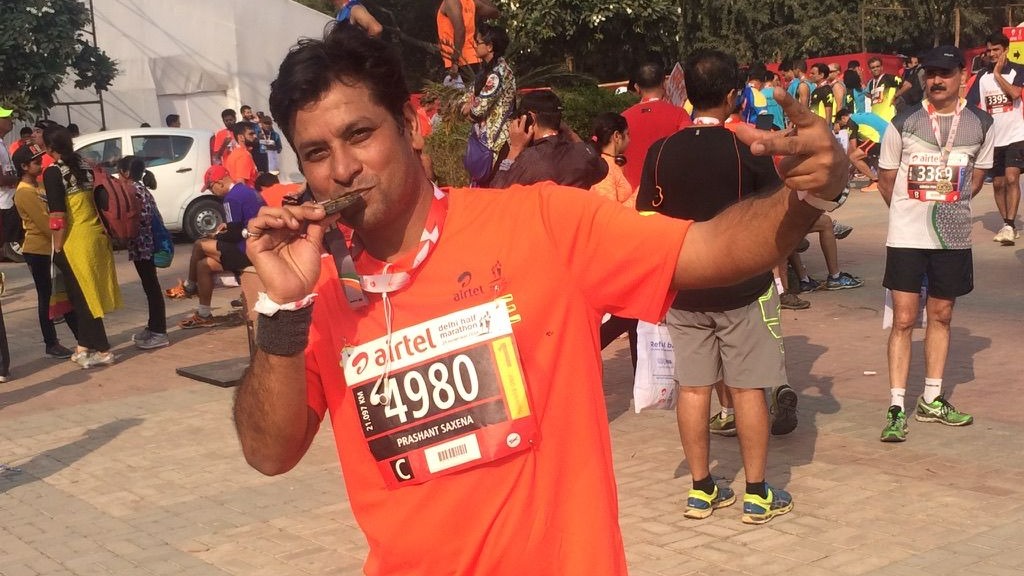
In the world of endurance sports, the Vedanta Delhi Half Marathon brings together both celebrated athletes and everyday runners with unique stories. Among the many participants this year is Prashant Saxena, a 51-year-old who embodies the spirit of resilience that resonates deeply with those familiar with the endurance journey.
Saxena’s foray into running is rooted in personal adversity—he faced colon cancer not once, but twice. Diagnosed in 2002, he underwent rigorous treatment that would change his outlook on life. The path to recovery was filled with uncertainty, yet it laid the foundation for what came next. Like many endurance athletes, his experience highlights a critical aspect of our sport: how we adapt, both mentally and physically, to the challenges we face.
In the face of his illness, Saxena emerged with a renewed sense of purpose. He turned to running not merely as a form of exercise, but as a vehicle for mental fortitude. The simple act of running became a metaphor for reclaiming control over his life. He shares how his initial steps were daunting; each kilometer felt overwhelming after his treatment left him breathless. Yet, with each run, he redefined his limits, slowly building his endurance. It reflects a fundamental truth of endurance sports: progress is often incremental, marked by those small victories that lay the groundwork for greater achievements.
Saxena credits Dr. Sudip Kumar, a friend’s brother and seasoned runner, for helping to reframe his approach toward running. Rather than focusing solely on distance or competition, he took in the joy of simply moving his body. This philosophy is crucial for endurance athletes; enjoying the process often outweighs the numbers on a watch. When running became about sensation and experience rather than mere metrics, Saxena found an intrinsic motivation that fueled his journey forward.
Returning to running after his first bout with cancer birthed not just a newfound passion but an understanding of pacing—both in running and in life. His experience underlines the importance of incremental progress, advising new runners to focus on enjoyment rather than ambitious pacing goals. Starting with manageable distances shifted his focus from competition to self-acceptance, a mindset many seasoned athletes can relate to. Training might not always yield the results we anticipate, and that’s a universal truth that transcends the metrics we often fixate on.
Tragedy struck again with the recurrence of his cancer in 2012. In one swift moment, his world turned upside down once more. Yet, this point of uncertainty also became fertile ground for growth. Many distance runners understand that setbacks are an inevitable part of our journey. It’s during these times that we dig deep, balancing disappointment with the resolve to continue on despite challenges. For Saxena, the support of family and friends was instrumental; it symbolizes the communal aspect of endurance sports—the bonds we form and the encouragement we exchange. During our toughest races, knowing that others share our struggles can be transformative.
As he navigated physical recovery, Saxena learned to listen to his body more carefully, recognizing the fine balance between pushing limits and respecting them. He emphasizes that running is not merely about speed; it’s about understanding one’s body, adapting training to fit those needs, and cultivating a mindset that fosters endurance. The interplay of physical capability and mental resilience shines a light on the duality athletes face in their training. Progress is rarely linear, and set-backs are often accompanied by deeper insights about our capabilities.
For Saxena, running is an individual pursuit intertwined with personal metrics. He aims not to race against elite competitors, but to beat his own records. The mental aspect of this philosophy is crucial; it underscores that your only competitor is often yourself. Whether you’re aiming to shave minutes off your time or simply complete the course, this internal dialogue defines what it means to be an endurance athlete. Each session becomes a canvas, painted with the strokes of effort and realization, leading to personal growth beyond the clock.
As he approaches the Delhi Half Marathon—hoping to downshift his time from two hours and 45 minutes to a more ambitious two hours and 10 minutes—his story serves as a testament to the mental framework that is indispensable in endurance sports. Saxena recognizes the importance of setting goals, but he also reminds us that the journey remains paramount. This kind of mindset helps sustain distance runners through grueling training months and races that test both physical limits and mental grit.
In his reflections, Saxena emphasizes a message that applies universally within the endurance community: the ability to find joy and meaning in both the struggles and triumphs of our pursuits. It’s a lesson learned on many long runs—that the act itself carries profound significance. Running is far more than achieving a numerical outcome; it’s about embracing the journey, battling the inevitable lows, and celebrating the highs alongside fellow athletes.
As an athlete, the takeaway from Saxena’s journey resonates deeply: amidst the quest for performance and improvement, remember to find joy in every step. Rely on your mental resilience, nurture your relationships within the running community, and recognize that every step—whether fast or slow—brings you closer to your personal goals. The beauty of endurance lies not just in the finish lines we cross but in the continuous commitment to our craft and the stories we cultivate on the roads we travel.
