


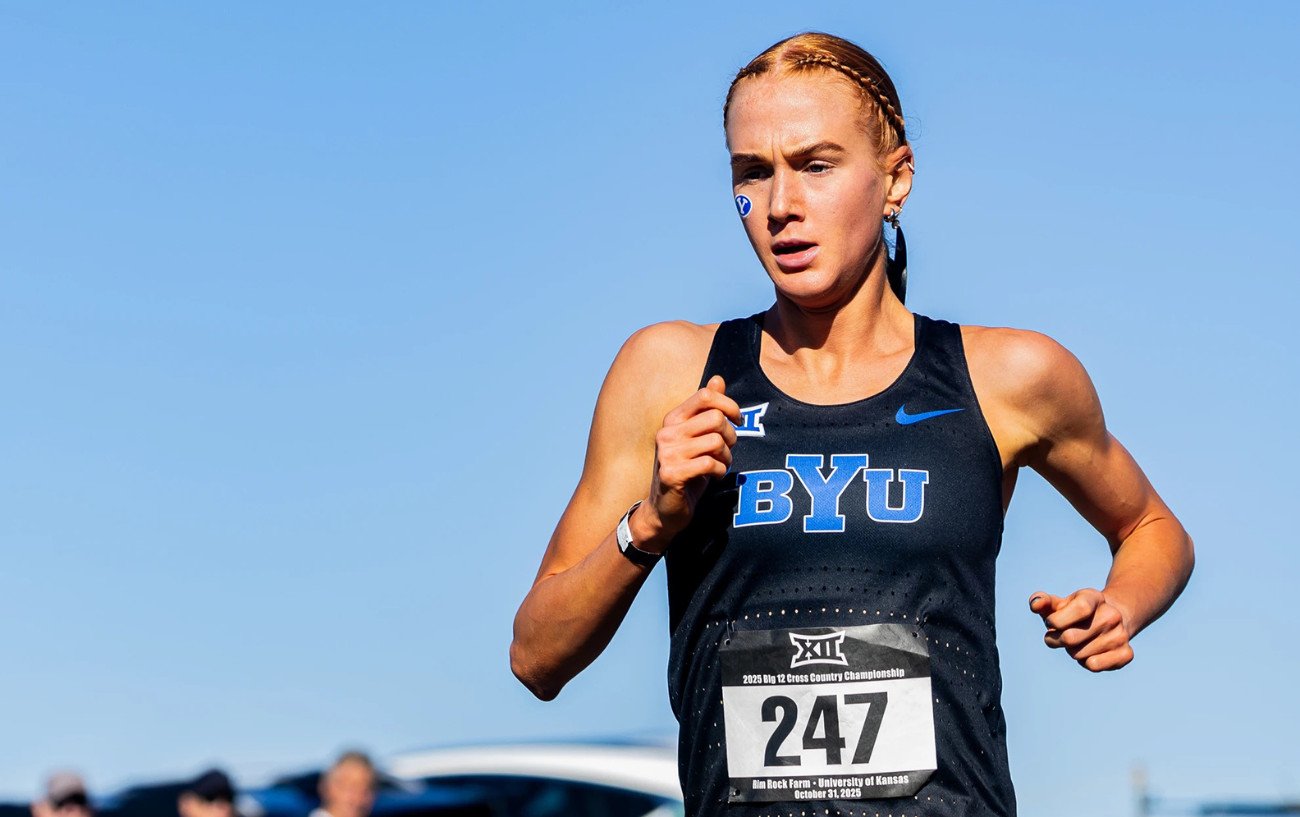
This autumn in NCAA cross country is under the captivating spotlight of Jane Hedengren, an 18-year-old phenomenon from Provo, Utah. Her debut semester at BYU has not merely turned heads; it has reshaped the narrative surrounding collegiate distance running.
In just three races donning the Cougar uniform, Hedengren has managed to defeat her competition with an alarming ease that renders them mere participants in a race she seems destined to dominate. Each time she has raced, it has been apparent that she won’t merely lead; she has left considerable gaps behind her contenders even before the halfway mark.
The speed of her ascent can overshadow her pre-existing accolades. Arriving at BYU, she was not an unknown talent; she entered with a staggering collection of nine national high school records. The times she set in high school position her on the cusp of an elite echelon, indicative of what the NCAA future may hold had those performances surfaced just months later.
Coach Diljeet Taylor has somewhat restrained her praise for Dixon, carefully articulating, “She’s one-of-one. She constantly seeks improvement and has her eyes set on the larger picture, envisioning global championships in four or five years.” Such accolades come from a seasoned coach who has nurtured NCAA champions before, although even she playfully describes Hedengren as “Jane-erational.”
The Road to Success
Hedengren’s remarkable talent did not simply erupt overnight; it has been honed through four years at Timpview High School. Over these formative years, she continually redefined what was perceived as achievable for American high school distance runners.
She kicked off her high school career by breaking the Utah state mile record and subsequently enhancing it. Notably, she recorded the fastest-ever 5K time by a U.S. high-school girl on a cross-country course, finishing under the remarkable threshold of 16 minutes, prompting coaches nationwide to reconsider their recruitment strategies.
During her appearances at Nike Cross Nationals, she established a monumental 41-second victory margin, the largest in the event’s history. However, it was her senior track season that solidified her legacy. She achieved a blistering 4:23.50 for the mile and a record-setting 14:57.93 for 5000m. For context, her 5,000m performance would have placed her sixth on the NCAA all-time list if she had run it as a freshman, indicating that her success was not merely an anomaly.
Upon graduation, she was courted by a plethora of the most esteemed collegiate programs. In a surprising turn, she opted to stay at home, stating, “This school is special because of the relationships, Coach Taylor, and the collective knowledge you gain here.” This decision holds familial significance, as her father, John, ran for BYU in the 1990s and now teaches chemical engineering at the institution, while her brother, Isaac, competes on the BYU men’s team.
Impressive Track and Field Records
Track Personal Records (PRs):
- 1500m: 4:08-high (HS national-class, Utah state record)
- 1 mile: 4:23.50 (US high-school national record)
- 3000m: 8:40:03
- 3200m: 9:14.65
- 2 mile: 9:17.75 (High School Record)
- 5000m (track): 14:57.93 (US high-school national record; would rank #6 NCAA all-time)
Cross-Country Records and PRs:
- 5K XC: sub-16:00 (US high-school fastest performance)
- NXN victory margin: 41 seconds (largest in event history)
Freshman College Course Records (Fall 2025):
- Gans Creek (Pre-Nats): 18:42.3 (course record)
- Rim Rock Farm / Big 12 Championships: 18:29.6 (Big 12 6K record; fastest ever on the course)
A Launch into Collegiate Racing
BYU did not hasten in ushering Hedengren into racing; Coach Taylor is known for her caution with freshmen expected to bear the brunt of competition pressure. When Hedengren made her collegiate debut at the Pre-National Invitational, anticipation hung heavy in the air surrounding her. It wasn’t about if she could win, but instead by what margin—a question she answered decisively: 23.5 seconds.
In her next race, at the Big 12 Championship, Hedengren further solidified her prowess by shattering the conference record by over half a minute, meanwhile securing another team title for BYU. The approach was meticulously measured—Hedengren followed the pacing strategy perfectly.
The Mountain Regional was anticipated as her ultimate trial, pitting her against Pamela Kosgei, the prior year’s NCAA runner-up. Yet again, Hedengren proved her mettle, winning by yet another impressive margin of 42.1 seconds, showcasing her capacity to dictate race dynamics.
The Upcoming NCAA Championship: A Historic Opportunity
The impending NCAA Championship presents a highly anticipated contest: Hedengren versus Doris Lemngole, an Alabama standout who edged out the NCAA field last year. It’s a rare occasion owing to their differing schedules that they have yet to face off this season, each brimming with distinctive strengths.
While Lemngole boasts invaluable experience and a powerful finish, Hedengren carries unrivaled momentum, ready to set the pace and break open the race long before the finish line. Achieving victory at the NCAA level requires not just talent, but also strategic finesse—something Hedengren has demonstrated with her tactical approach.
With four decades having passed since a true freshman seized the NCAA women’s title—an honor bestowed solely to NC State’s Suzie Tuffey in 1985—the narrative surrounding Hedengren has grown intriguing. Even though she is new to collegiate running, her past performances resonate strongly in the present.
As the Championship approaches with increasing anticipation, the conversation around BYU’s need for a dependable low stick has evolved dramatically. Jane Hedengren has emerged as an exceptional individual reshaping expectations and solidifying her position as a front-runner in collegiate athletics.
The accrued accolades raise one pertinent question in the minds of thousands: If Hedengren takes the lead early, can anyone keep pace? Only time will reveal the answer.
